
Solutions

Cover the entire customer journey

Pick the AI pattern that fits where your customers actually need help — from public discovery to internal team co-pilots.

Acquisition

Increase conversion rates and reduce the amount of incoming support tickets.

Retention and upsells

Improve retention, supercharge sales expansion, and deflect support tickets.

Self-service support

Offer your customers 24/7 support, in websites or client portal.

Co-pilot for support teams

Reduce support ticket handling time in customer support teams.

Features

One-stop-shop for your AI solution

Everything you need to ship AI in production — from no-code components to enterprise governance, all on one compliant foundation.

Agentic AI

Combine AI assistance, semantic search, and agentic tasks for 24/7 support.

No-code management

Easy UI integration with 20+ templates, automated AI training, and clear insights.

Integrates anywhere

Unlock your existing business systems with any of our 50+ connectors.

Privacy and security

Benefit from enterprise-grade privacy protection for European sectors.

Customers

Trusted by leaders

How regulated-Europe brands — from Visma to Onguard — turned customer success into a revenue engine with Unless.

Visma Enterprise AS

Norway's leading ERP — modernized self-service with Unless.

Helping patients

After Zorgdomein deployed Unless, patient self-service surged within weeks.

Enhancing credit software

Financial service Onguard powers their support operations with Unless.

Ticket deflection at scale

Meet Sally, Kontek’s AI support colleague in a complex regulatory landscape.

Resources

Resources and support

Documentation, articles, and recipes for getting the most out of your Unless deployment — plus a help desk when you need a human.

Help center

Read how to get started of find advanced guides to help you using our platform.

Security and compliance

Privacy protection measures, security by design, and compliance guidelines.

Developer documentation

Find reference documentation for the javascript API.

The Unless cookbook

Bite-sized implementation examples for every stage of the customer lifecycle.

Pricing

Subscription plans

Transparent plans for every team size — start with a free pilot, scale to enterprise with a phased implementation plan.

High level plan overview

Our subscription plans cover your entire user journey with three use cases.

Additional services

We offer premium support, custom development and integrations.

Compare plans

Choose the right subscription plan with this feature comparison table.

Frequently asked questions

Check out the list of what others asked our sales reps.

Article

Audiences based on URL parameters

Learn how to send data from any source (e.g. Facebook, ads, a CRM, a form, email,...) to Unless to create an improved website experience.

Updated 8 January 2025

What are URL parameters?

Parameters are little snippets of information, added to a URL. They transfer information between places and are great for creating an enhanced website experience. The information transferred through parameters can come from

  • ad networks (e.g. Facebook, AdWords)
  • your own data sources (CRM or ESP)
  • your website (= a hash or string at the end of a URL)

Targeting options for parameter-based audiences

  • UTM source: Create an audience based on the utm_source attached to the URL. Example: utm_source=adwords
  • UTM medium: Create an audience based on the utm_medium attached to the URL. Example: utm_medium=paid-search
  • UTM campaign: Create an audience based on the utm_campaign attached to the URL. Example: utm_campaign=shoe-promotion
  • UTM content: Create an audience based on the utm_content attached to the URL. Best practice suggest to use "content" to describe the ad/newsletter/post, which allows for identifying individual promotions. Example: utm_content=summer-shoes
  • UTM term: Create an audience based on the utm_term attached to the URL. It is typically used to identify keywords for paid ads. Example: utm_term=black-leather-boots

Setting up an audience based on URL parameters for a holiday promo campaign

  • Hash: Hash marks (#) introduce an optional fragment near the end of the URL. They're typically used in eCommerce and affiliate marketing.
  • Query String Parameters: Query string parameters are used for sending information through the URL (e.g. example.com/?search=dresses).
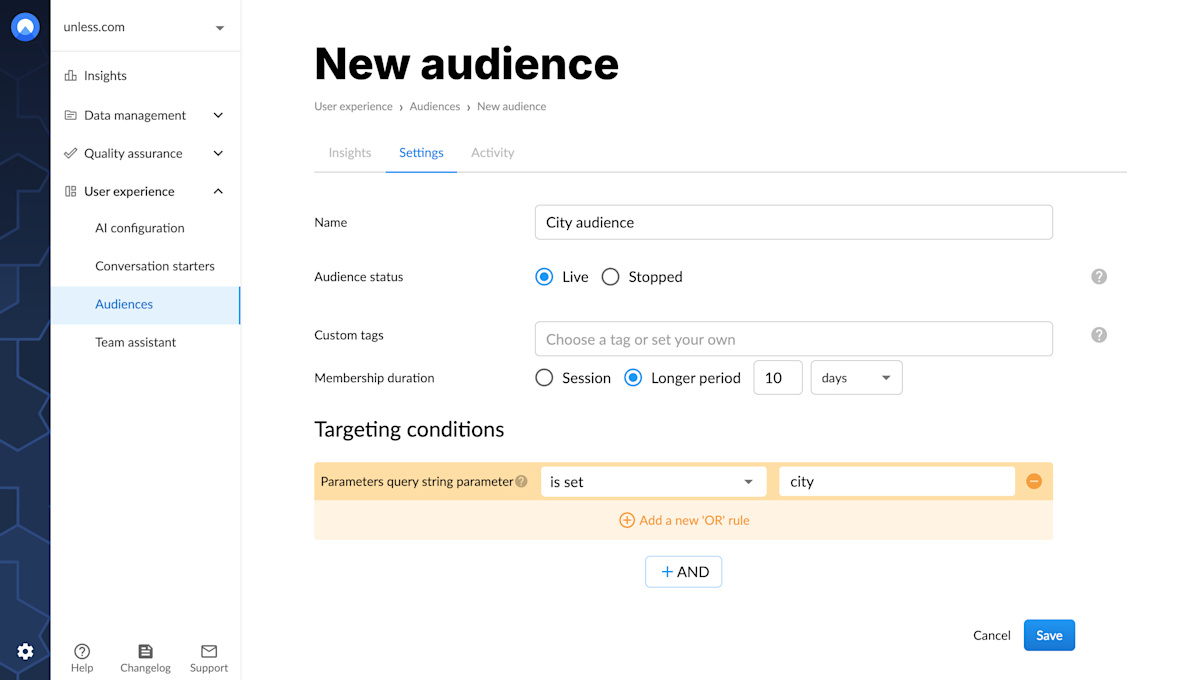
Setting up an audience based on the query string parameter

Here we selected "city" as the query parameter key. So, that matches mysite.com/?city=Amsterdam, ?city=Paris, ?city=London... To target a specific key value (e.g. Amsterdam) you would have to change the trigger to "city=Amsterdam".

Tips and best practices

  • The triggers "is empty" and "is not empty" are particularly useful here to set up audiences that trigger if no (or any) parameter is set.
  • When applicable, try to use the "contains" trigger instead of "equals". This is especially true for triggers based on parameters. For example, if you used "utm_source equals adwords" but the link is "mysite/?utm_source=adwords/", the experience wouldn't trigger correctly. The / at the end of the link wouldn't be an exact match.
  • Query String Parameters are the most powerful targeting condition. With query string parameters, you can leverage information stored by your email service or CRM platform (e.g. your lead's job title).
  • Remember to correctly use the AND/OR function. For example: You can target visitors from two UTM campaigns but a person can only view one ad campaign at a time. So, use the "OR" function to combine those triggers.


Related content

Article

How to set up audiences

Defining audiences is the first step in developing an effective optimization strategy. Here's how to create audiences with Unless.

We're here to help

Quick responses if you have an issue. Feel free to ask us anything — or ask our conversational AI a question.